Clients
Starting counselling can feel like a big step, especially if it’s your first time. At The Well Counselling we may be able to help you access counselling if you are over 18 and live in the Malvern area. We have gathered the questions we are most often asked to help you understand how counselling works at The Well Counselling. Whatever has brought you here, you are welcome.
If you can’t find what you’re looking for, please get in touch—we’ll be happy to help.
Before you begin
What is counselling?
Counselling (or psychotherapy) is a professional relationship that offers a safe, confidential space to explore your thoughts, feelings and experiences. Rather than giving advice or telling you what to do, a counsellor will work alongside you to help you better understand yourself, make sense of your experiences, and discover your own ways forward.
People seek counselling for many different reasons, including anxiety, depression, bereavement, relationship difficulties, trauma, low self-esteem, life transitions and many other concerns.
- Anxiety and panic attacks
- Bereavement and loss
- Confidence and self-esteem
- Confusion, despair, sadness or anger
- Coping with illness or disability
- Depression
- Difficulty coping with everyday issues
- Relationship issues
- Stress
- Violence and abuse
- Work related issues
View more information on the British Association for Counselling and Psychotherapy (BACP) website
View more information on the The Association of Christians in Counselling (ACC) website
Is counselling right for me?
Counselling can be helpful for many people who are finding life difficult or who would benefit from a regular space to reflect on their experiences. You don’t need to be in crisis to seek support.
Your counsellor will begin with an initial assessment to understand your needs, answer any questions you have, and consider together whether counselling is likely to be the most helpful approach. If another type of support would be more appropriate, we’ll do our best to help point you in the right direction.
Is counselling suitable for everyone?
Counselling isn’t always the most appropriate support, particularly if someone is experiencing an immediate mental health crisis, requires specialist psychiatric care, or is unable to engage safely in the counselling process at that time.
In particular our services may not be suitable for such as:
- Chronic drug addiction & alcoholism
- Chronically incapacitating phobic symptoms
- Chronically incapacitating obsessional symptoms
- Gross destructive and self-destructive acting out
- Severe eating disorders
- Bi-polar unless been stable for some time
- Confirmed homosexual asking to be made heterosexual
- Being seen by Mental Health team, unless the client agrees to our contacting the Mental Health Team and all parties agree we are an appropriate service for the client
- A client is seeing a psychiatrist or psychologist at the current time or in the past six months, unless the client agrees to our speaking to them and all parties agree we are an appropriate service for the client
- A client who is taking or has been prescribed anti-psychotic drugs, unless the client agrees to our speaking to the doctor who prescribed the medication and all parties agree we are an appropriate service for the client
- Situations involving a current or pending legal process may also mean that counselling will not be offered.
How much does counselling cost?
We believe that access to counselling should depend more on need than on income. Private counselling often costs from around £50 per session or more. Choosing a private counsellor directly may offer greater flexibility if you’re able to meet the full cost yourself. A limited amount of counselling may be available to you from the NHS, but you often need to wait through their systems to access this.
At The Well Counselling, we operate a shared-cost model. Your counsellor will have an open conversation with you about what you can realistically afford to contribute, with the remaining cost supported through charitable funding where available. We want cost to be a conversation, not a barrier.
Do I have to live in Malvern?
The Well Counselling is available to anyone over 18 who lives within our defined catchment area traced on the map below.
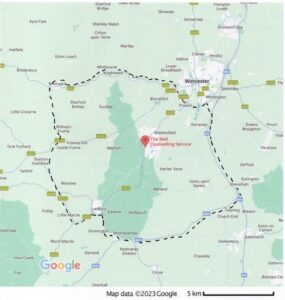
If you live outside our catchment area, other support may be available.
What other support is available?
Counselling is one form of support, but it isn’t the only one. Depending on your circumstances, you may also find help through community wellbeing groups, peer support, pastoral care, coaching, or other specialist services.
If you’re looking for a private counsellor outside The Well, the ACC and BACP directories are good places to begin, there is also The Counselling Directory. NHS funded options may be available from Talking Therapies or through your GP.
We can help you access subsidised face to face counselling and online counselling if you are aged 18 years and above and live in Malvern and the immediate surrounding areas. If you live outside our catchment area, the following local services may be appropriate:
Counselling agencies
The Bridge Counselling Service
Counselling for adults in Worcestershire
Listening Post
Counselling for adults in Gloucestershire
Marches Counselling Service
Counselling for adults in Herefordshire
Starting Counselling
What happens first?
Once you’ve completed our contact form, we will respond using your preferred method of contact to answer any questions and gather a little more information about what you’re looking for. There’s no obligation to continue after making an enquiry, and you can withdraw at any time.
If you’d like to go ahead, we’ll ask you to complete our data-sharing agreement and pay a £10 registration fee. We’ll then introduce you to an available associate counsellor, who will arrange an initial assessment session.
What should I expect?
Your first session is usually a little more structured than later appointments. It gives your counsellor the opportunity to understand what’s brought you to counselling, answer your questions, and explore whether you’re likely to work well together.
This conversation may also include practical matters such as confidentiality, how counselling works, and agreeing a contribution that feels affordable. Every counsellor works a little differently, but all aim to provide a safe, respectful space where you can explore what’s important to you at your own pace.
Can I choose my counsellor?
We normally suggest a counsellor based on availability and the information you’ve shared with us. Wherever possible, we will also take into account preferences such as gender, accessibility needs, or practical arrangements.
Finding the right therapeutic relationship matters. If, after meeting your counsellor, you don’t feel the match is right, please let them -or us- know. If another counsellor is available, we’ll do our best to help.
Is there a waiting list?
Waiting times vary depending on demand and counsellor availability, but we generally aim to offer appointments sooner than many NHS talking therapy services.
We’ll always try to give you an honest indication of likely waiting times. Greater flexibility around days and times may allow us to match you with a counsellor more quickly.
Where do sessions take place?
Some of our associate counsellors meet clients in our dedicated counselling suite at 6 Church Street, Great Malvern, while others work from their own consulting rooms or online.
Let us know what works best for you and we’ll take this into account when matching you with a counsellor.
How long are sessions?
Most counselling sessions last around 50 minutes.
Many people find it helpful to leave themselves a little time before or afterwards, allowing space to arrive calmly or reflect before returning to the rest of their day.
How many sessions will I need?
There isn’t a single answer to this. Some people come for a relatively short period, while others benefit from longer-term counselling.
Your counsellor will discuss this with you as part of your assessment and review progress together with you, usually around six-session intervals.
Through our charitable funding, we are normally able to subsidise up to 20 weekly sessions for each client, although this may occasionally be extended where circumstances allow.
Practical Information
Is everything confidential?
Yes. Both The Well Counselling and your associate counsellor have secure systems for handling your information, and confidentiality will be explained clearly before counselling begins.
To introduce you to a counsellor, we’ll share the information needed to arrange your assessment. Once counselling has started, the conversations you have with your counsellor remain confidential and are not shared with The Well Counselling unless you have given explicit permission.
The Well Counselling may receive limited administrative information—such as the number of sessions attended, agreed client contribution, or anonymous feedback—to help us manage the service and secure future charitable funding.
Like all professional counsellors, your counsellor may occasionally have a legal or ethical duty to break confidentiality where there are serious concerns about safety. They will explain these circumstances fully before counselling begins.
How do I know it's safe?
All of our associate counsellors are professionally qualified and registered with recognised professional bodies. They practise according to their own professional codes of ethics, undertake regular supervision, and maintain ongoing professional development.
The Well Counselling also operates safeguarding, data protection and governance policies to ensure the service is delivered responsibly and safely.
What if I have a complaint?
If your concern relates to the counselling itself, it should normally be raised with your counsellor in the first instance. As independent practitioners, they are responsible for their own professional practice and complaints process, which will be explained in your agreement with them.
If your concern relates to The Well Counselling—for example, our administration or how the service has been managed—you can raise this with our administrator or manager. If necessary, concerns can be escalated through our complaints procedure or to our Board of Trustees.
If you feel Counselling could be right for you, we’d be pleased for you to get in touch.
The Well Counselling is not a crisis or emergency service. If you are facing a mental health crisis please consider reaching out to your GP, calling the Samaritans, or in life-threatening emergencies call 999.